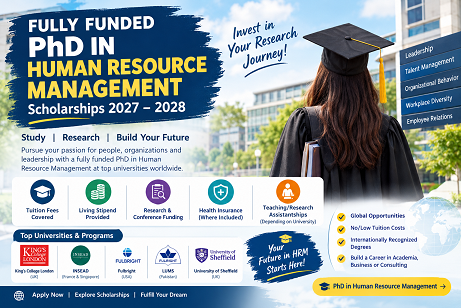
A Fully Funded PhD in Human Resource Management is an excellent opportunity for students who want to pursue advanced research in employee management, organizational behavior, leadership, workplace diversity, talent development, and business strategy. These doctoral opportunities can help qualified candidates earn a research degree while receiving financial support for their education and living expenses.
Universities in the United Kingdom, United States, France, Singapore, and other countries offer doctoral funding through scholarships, research studentships, graduate assistantships, and university fellowships. Some opportunities specifically focus on human resource management, employment relations, or organizational behavior, while others are available through broader PhD programs in management and business administration.
For the 2027–2028 academic year, prospective applicants should investigate upcoming scholarship announcements and check the latest eligibility requirements before applying. Funding arrangements vary by institution, and not every scholarship covers all expenses.
This guide explains the available funding routes, universities to investigate, eligibility criteria, application documents, and practical steps for finding a suitable PhD opportunity.
What Is a Fully Funded PhD in Human Resource Management?
A PhD in Human Resource Management is an advanced research degree focused on how organizations recruit, develop, motivate, manage, and retain employees. Students investigate workplace challenges and develop research that can improve organizational performance and employee experiences.
A fully funded doctoral position generally provides financial assistance that may include:
- Full tuition coverage: Payment of eligible university tuition fees.
- Living stipend: Regular financial support for accommodation, food, and everyday expenses.
- Research funding: Support for approved research activities, conferences, and academic resources.
- Health insurance: Coverage where included in the funding agreement.
- Teaching or research assistantships: Paid or funded academic responsibilities, depending on the university.
Applicants should carefully read each award’s conditions. Some scholarships cover tuition and provide a stipend, whereas others offer only a tuition waiver or partial financial assistance.
Best Fully Funded PhD Opportunities to Explore for 2027–2028
The following universities and scholarship programs are useful starting points for students seeking doctoral funding in HRM-related research. Program availability, deadlines, and eligibility can change, so confirm current details through the official websites.
1. King’s College London, United Kingdom
King’s Business School offers doctoral research opportunities in management, including research areas related to Human Resource Management and Employment Relations.
Its doctoral research studentships page advertises funded opportunities for the 2027–2028 academic year, including international studentships. The published funding information describes tuition-fee coverage and a tax-free stipend, with teaching or marking responsibilities expected as part of the academic experience.
Students interested in employment relations, workplace inequalities, organizational management, and employee experiences may find this opportunity relevant.
Funding may include:
- Eligible tuition fees.
- A living stipend.
- Academic development and research opportunities.
- Experience supporting teaching and marking. Official link:-
Applicants should confirm the specific studentship’s coverage, duration, application deadline, and HRM research eligibility before submitting an application.
2. INSEAD PhD in Management, France and Singapore
INSEAD offers a PhD in Management with research opportunities across several business disciplines. Depending on the available research areas and faculty interests, prospective candidates may investigate organizational behavior, leadership, and related organizational topics.
INSEAD states that all admitted PhD students receive its fellowship for the first five years of full-time study, subject to satisfactory academic progress and annual renewal. The published package includes a tuition-fee waiver, stipend, research and conference budget, and health insurance.
This makes INSEAD an option for students whose proposed HRM-related research fits one of its available management specializations.
Funding benefits include:
- Tuition-fee waiver.
- Financial support for living expenses and accommodation.
- Research and conference funding.
- Health insurance, according to program conditions. Official Website
Before applying, review the current research areas and determine whether your proposed topic fits the program.
3. Fulbright Foreign Student Program, United States
The Fulbright Foreign Student Program supports eligible international students pursuing graduate education and research in the United States. Doctoral study may be possible under the relevant country’s award rules and current program arrangements.
For applicants from Pakistan and other participating countries, application procedures and eligibility requirements are administered by the relevant Fulbright commission, foundation, or US embassy.
Depending on the country and award, funding can include educational support, health benefits, and other approved expenses. The exact package and whether a PhD in HRM is eligible must be confirmed through the applicant’s national program.
Potential benefits include:
- Financial support for eligible graduate study.
- Opportunities to study and conduct research in the United States.
- Health-related benefits under the award terms.
- Academic and cultural exchange opportunities. Official link
Applicants should verify whether doctoral applications are accepted for the relevant cycle, as national programs can have different eligibility rules, deadlines, and degree restrictions.
4. Lahore University of Management Sciences (LUMS), Pakistan
Students who prefer to pursue doctoral research in Pakistan should investigate the PhD Management program at Lahore University of Management Sciences.
LUMS describes its PhD programs as fully funded for four years, with support that can cover admission fees, tuition fees, semester registration fees, and a monthly stipend subject to university policy and approval requirements. Funding is subject to academic performance and applicable program conditions.
Although this is a PhD in Management rather than a degree titled exclusively Human Resource Management, applicants may investigate whether their proposed HRM research fits the program’s research areas and available supervision.
Potential topics include leadership, employee motivation, organizational behavior, human capital development, and workplace management.
Funding may include:
- Admission and tuition fees.
- Semester registration fees.
- A monthly stipend, subject to applicable conditions.
- Possible additional support through teaching assistantships. Official link
Applicants should contact the university to confirm current admission requirements, research supervision availability, and the terms of the funding package for the intended intake.
5. University of Sheffield, United Kingdom
The University of Sheffield Management School provides information about doctoral scholarships and funded research projects. These opportunities can be relevant to applicants interested in management, organizational studies, employee relations, and related social science research.
Funding depends on the particular scholarship or research project. Some advertised opportunities have covered international tuition fees, an annual stipend, and research training expenses.
However, individual funding calls have specific deadlines and research requirements. Applicants should not assume that a previously advertised scholarship remains open for 2027–2028. Official link
Check the website for new announcements, international eligibility, available supervisors, and the required research proposal.
Popular Research Areas in Human Resource Management
A strong PhD application begins with a clear research interest. Human Resource Management includes several specializations that may be suitable for doctoral research.
1. Strategic Human Resource Management
This area investigates how HR policies contribute to organizational performance, business strategy, and long-term growth.
2. Organizational Behavior
Students explore employee motivation, leadership, teamwork, job satisfaction, workplace culture, and decision-making.
3. Talent Management and Employee Retention
Research focuses on recruitment, employee development, succession planning, and strategies for retaining skilled workers.
4. Diversity, Equity, and Inclusion
This field examines workplace fairness, inclusive leadership, equal opportunities, and organizational policies affecting different employee groups.
5. Artificial Intelligence in Human Resources
Researchers investigate how AI and digital technologies influence recruitment, performance evaluation, workforce planning, and HR decision-making.
6. Employee Wellbeing and Workplace Practices
This research area explores work-life balance, employee engagement, flexible working arrangements, and organizational approaches to workplace wellbeing.
Choosing a focused topic can help you identify suitable supervisors and improve the quality of your research proposal.
Eligibility Criteria for Fully Funded HRM PhD Scholarships
Eligibility differs between universities, doctoral programs, and scholarship providers. Nevertheless, applicants are commonly assessed on the following factors.
Academic qualifications: Many research-intensive PhD programs expect a relevant master’s degree, while some accept outstanding applicants with a bachelor’s degree or an alternative qualification.
Academic performance: Strong grades and evidence of research ability can improve an applicant’s competitiveness.
Research proposal: Applicants may need to explain their proposed topic, research questions, methodology, academic contribution, and reasons for choosing the university.
English-language proficiency: International applicants may need IELTS, TOEFL, or another accepted qualification, depending on the institution’s rules and exemptions.
Research experience: A master’s dissertation, research assistantship, published paper, or relevant professional experience may strengthen an application.
References: Academic recommendations can demonstrate research potential, independent thinking, and the ability to complete doctoral-level work.
Supervisor compatibility: Some universities require applicants to identify a suitable supervisor, while others assign supervisors during the admission process.
Meeting minimum eligibility requirements does not guarantee admission or funding. Competitive awards usually assess the overall strength of the application.
Required Documents for a PhD Scholarship Application
Prepare the following documents before applying, while checking the official requirements of each institution:
- Updated academic CV or résumé.
- Academic transcripts and degree certificates.
- Research proposal.
- Statement of purpose or personal statement.
- Academic recommendation letters.
- Proof of English proficiency, if required.
- Master’s thesis or relevant writing sample, if requested.
- Passport or other identification documents required for admission.
- Publications or evidence of research experience, where applicable.
Some universities also request interviews, additional tests, a writing sample, or a separate funding application.
How to Apply for a Fully Funded PhD in Human Resource Management
Step 1: Identify Suitable Universities
Search university websites for terms such as “PhD Human Resource Management,” “PhD Management,” “Organizational Behaviour PhD,” “Employment Relations PhD,” and “fully funded doctoral studentship.”
A broader search is important because HRM research is often offered within management, business, or organizational studies departments.
Step 2: Check Funding Details
Read the scholarship information carefully. Confirm whether it covers international tuition fees, provides a living stipend, supports research expenses, and includes health insurance.
Also check the duration of funding and whether renewal depends on satisfactory academic progress.
Step 3: Find a Research Supervisor
Review faculty profiles and recent publications to identify academics whose research interests match your proposed topic.
If the university permits or requires contact with a prospective supervisor, send a concise and professional email describing your background, research interests, and reasons for approaching them.
Step 4: Prepare a Strong Research Proposal
Your proposal should explain the problem you want to investigate, the research questions, the relevant academic literature, your proposed methodology, and the potential contribution of the study.
For example, a proposal might examine how hybrid working arrangements affect employee engagement and retention in technology companies.
Step 5: Submit Your Application
Complete the university’s online application and upload all required documents before the deadline. If the scholarship requires a separate form, submit that application as well.
Step 6: Prepare for an Interview
If shortlisted, be prepared to explain your research topic, why it matters, how you plan to investigate it, and why the university is suitable for your academic goals.
Step 7: Review the Funding Offer
Before accepting admission, read the written funding offer. Confirm the stipend, fee coverage, duration, teaching obligations, renewal conditions, and any costs that remain your responsibility.
Tips to Improve Your Chances of Receiving a PhD Scholarship
Competition for fully funded doctoral positions can be strong. These steps may help you prepare a more convincing application:
- Develop a focused research question instead of choosing an overly broad subject.
- Explain how your project contributes to existing HRM research.
- Match your proposal with the expertise of the department and potential supervisor.
- Demonstrate research skills through your thesis, relevant work, or academic projects.
- Request references from academics who know your research abilities.
- Apply to several suitable programs rather than relying on one university.
- Start preparing early and track deadlines in a spreadsheet or calendar.
- Check whether funding consideration is automatic or requires a separate application.
Avoid paying anyone who promises guaranteed admission or a scholarship. Always verify opportunities through official university or scholarship-provider websites.
Career Opportunities After a PhD in Human Resource Management
A doctoral degree in HRM can prepare graduates for research-focused careers in academia, business, consulting, and policy development.
Potential career paths include:
- University lecturer or professor, subject to institutional requirements.
- HRM researcher or organizational behavior researcher.
- Management consultant.
- Workforce strategy specialist.
- Organizational development consultant.
- Employee relations researcher.
- Research analyst in public policy or labor studies.
- Corporate research and people analytics specialist.
Career opportunities depend on the graduate’s skills, experience, location, and the requirements of individual employers. A PhD is particularly valuable for roles that require advanced research, university teaching, or evidence-based organizational analysis.
Frequently Asked Questions (FAQs)
Can I study for a PhD in Human Resource Management without paying tuition fees?
Yes. Some universities offer fully funded doctoral positions that cover eligible tuition fees and provide a stipend. However, applicants must win a funded place, and additional expenses may not always be covered.
Are fully funded HRM PhD scholarships available to international students?
Yes. Some universities and scholarship programs accept international applicants. Funding eligibility, nationality requirements, and application procedures differ by institution.
Can I apply without a master’s degree?
Some universities accept exceptional applicants directly from a bachelor’s degree, while others require a relevant master’s qualification. Check the admission requirements of each program.
How long does a PhD in Human Resource Management take?
The duration varies by country and university. Many full-time doctoral programs take approximately three to five years, although some require longer.
Is IELTS mandatory for every international applicant?
No. English-language requirements depend on the institution, previous education, and accepted exemptions. Applicants should verify the current rules.
When should I apply for 2027–2028 admission?
Begin researching opportunities early and monitor official funding pages throughout the year. Deadlines differ, and some doctoral studentships close several months before the program begins.
Conclusion
A Fully Funded PhD in Human Resource Management can provide an important opportunity to develop advanced research skills without personally covering the full cost of doctoral education. Prospective students should explore dedicated HRM studentships alongside broader PhD programs in management, organizational behavior, and employment relations.
For 2027–2028, useful starting points include King’s Business School, INSEAD, the Fulbright Foreign Student Program, LUMS, and the University of Sheffield. Each offers a different route to doctoral study, and not every opportunity will match every HRM research topic.
The most effective approach is to identify a clear research interest, prepare a strong proposal, contact suitable academic departments when appropriate, and verify funding conditions through official websites. With careful preparation and timely applications, qualified candidates can improve their chances of finding a doctoral position that supports both their academic development and long-term career goals.