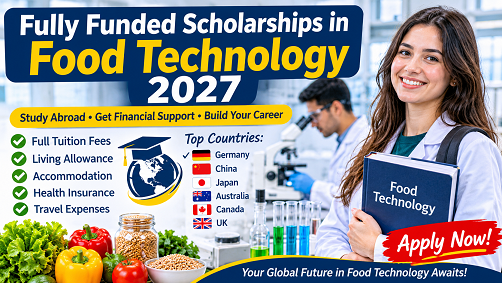
Are you interested in studying Food Technology abroad but worried about the cost of university education? Fully Funded Scholarships in Food Technology 2027 can help you achieve your academic dreams without putting a heavy financial burden on your family.
Food Technology is an important field that focuses on food production, food safety, food processing, nutrition, preservation, and product development. With the growing global population and increasing demand for safe and healthy food, skilled food technology professionals are needed in many countries.
Many universities and governments offer scholarships to talented international students who want to study Food Science, Food Technology, Food Engineering, and related subjects. These opportunities are available for bachelor’s, master’s, and PhD students.
Depending on the scholarship, students may receive full tuition fee coverage, monthly living allowances, accommodation support, health insurance, and travel expenses.
In this guide, you will discover scholarship opportunities, popular study destinations, eligibility requirements, application documents, and useful tips for applying successfully.
What Are Fully Funded Scholarships in Food Technology?
Fully funded scholarships are financial awards that help students cover the major costs of studying at a university. These scholarships are offered by governments, universities, research institutions, and international organisations.
Students interested in Food Technology can apply for scholarships in several related academic areas, including:
-
Food Science and Technology
-
Food Engineering
-
Food Microbiology
-
Food Safety and Quality Management
-
Food Processing and Preservation
-
Food Chemistry
-
Nutrition and Food Science
-
Agricultural and Food Sciences
-
Food Biotechnology
-
Sustainable Food Production
These subjects help students understand how food is produced, processed, stored, tested, and delivered safely to consumers.
The exact financial benefits depend on the scholarship provider. Some awards cover tuition fees and living expenses, while others provide additional support for accommodation, insurance, and international travel.
Why Study Food Technology Abroad in 2027?
Studying Food Technology abroad can provide students with valuable academic knowledge, practical experience, and international exposure.
Many universities have modern laboratories, food research centres, and advanced processing facilities. Students can learn about new technologies used to improve food quality, increase production, and reduce food waste.
Here are some important reasons to choose this field:
1. Growing Career Opportunities
Food companies, research laboratories, agricultural organisations, and government departments need qualified professionals who understand food safety and production.
2. International Education
Studying abroad allows students to experience different education systems, meet international researchers, and develop professional connections.
3. Practical Research Experience
Students may participate in research projects related to food preservation, packaging, nutrition, and food quality.
4. Affordable Education Through Scholarships
Fully funded awards can reduce or remove major education expenses, allowing talented students to focus on their studies.
5. Opportunities for Innovation
Food Technology graduates can contribute to developing healthier products, sustainable packaging, and better food preservation methods.
Top Countries Offering Food Technology Scholarships in 2027
International students can explore Food Technology scholarships in different countries. Several governments and universities provide financial support for students studying food science, agriculture, biotechnology, and related research subjects.
1. Germany:-
Germany is a popular destination for international students because of its strong universities and research facilities. Students interested in Food Technology can explore degrees in Food Science, Food Engineering, Agricultural Sciences, and Biotechnology.
Some universities offer scholarships and financial assistance to international students. Students can also investigate the German Academic Exchange Service (DAAD) scholarship database for suitable postgraduate funding opportunities.
Possible study areas include:
-
Food Quality and Safety
-
Food Processing Technology
-
Food Biotechnology
-
Agricultural and Food Sciences
-
Sustainable Food Production
Germany is especially attractive to students interested in scientific research and industrial food production.
2. China:-
China offers several scholarship opportunities for international students through government-funded and university-funded programmes.
The Chinese Government Scholarship (CSC) is one of the major funding opportunities for international applicants. Depending on the university and degree, students may find suitable programmes in Food Science, Food Engineering, Agricultural Sciences, and Biotechnology.
Scholarship benefits may include:
-
Full or partial tuition fee coverage.
-
University accommodation.
-
Monthly living allowance.
-
Medical insurance.
Students should check whether their selected university offers a relevant Food Technology degree and accepts international applicants for the 2027 intake.
3. Japan:-
Japan is known for advanced food research, food safety systems, food processing, and biotechnology.
International students can explore the Japanese Government MEXT Scholarship, which supports eligible international students at Japanese universities.
Students interested in Food Technology may find research opportunities in:
-
Food Microbiology
-
Food Chemistry
-
Food Preservation
-
Food Biotechnology
-
Agricultural Science
-
Nutrition Science
The MEXT Scholarship may provide tuition coverage, a monthly allowance, and travel support according to its applicable rules.
4. Australia:-
Australia has internationally recognised universities offering courses in food science, food technology, agricultural science, and nutrition.
International students can investigate university research scholarships and the Research Training Program (RTP), particularly for eligible research master’s and doctoral degrees.
Students may receive financial support for tuition fees and living expenses, depending on the award.
Research areas include food safety, sustainable agriculture, food product development, and food processing.
5. Canada:-
Canada is another attractive destination for students interested in Food Science and Technology.
Canadian universities offer research opportunities in food processing, food chemistry, agricultural sciences, and food safety.
International students can explore university graduate funding, research assistantships, and doctoral scholarship opportunities.
Some universities provide financial packages through research supervisors and graduate departments. However, funding availability and international eligibility vary by institution.
6. United Kingdom:-
The United Kingdom offers several postgraduate opportunities in Food Science, Food Technology, and related subjects.
International students can explore university scholarships, research studentships, and eligible government-funded awards.
The Commonwealth Scholarship programme may also be worth investigating for eligible students from Commonwealth countries who wish to pursue approved postgraduate courses.
Students should check the individual scholarship requirements because not every award covers every Food Technology subject.
Popular Fully Funded Scholarship Programmes to Explore
The following funding programmes may be relevant to international students interested in Food Technology and related research fields.
Scholarship programme Country
DAAD Scholarships Germany
Chinese Government Scholarship (CSC) China
MEXT Scholarship Japan
Research Training Program (RTP) Australia
University Graduate Research Scholarships Canada
Commonwealth Scholarships United kingdom
Erasmus Mundus Scholarships European countries
Important: These are established scholarship schemes, not guaranteed Food Technology awards. Applicants must identify an eligible university, course, or research project before applying. Funding conditions and available places can change each year.
Degree Programmes Available in Food Technology
Students can choose different academic levels depending on their previous education and career goals.
Bachelor’s Degree
A bachelor’s degree is suitable for students who have completed their higher secondary education.
Common subjects include:
-
Introduction to Food Science
-
Food Chemistry
-
Food Microbiology
-
Food Processing
-
Food Preservation
-
Human Nutrition
-
Food Quality Control
A bachelor’s degree generally takes three to four years, depending on the country and university.
Master’s Degree
A master’s degree is suitable for students who have completed a bachelor’s degree in Food Science, Food Technology, Agriculture, Chemistry, Biotechnology, or a related subject.
Popular specialisations include:
-
MSc Food Technology
-
MSc Food Science
-
MSc Food Safety
-
MSc Food Engineering
-
MSc Food Biotechnology
-
MSc Food Quality Management
Most master’s degrees take one to two years.
PhD Degree
A PhD is designed for students who want to conduct advanced research in Food Technology.
Research areas may include:
-
Food preservation and packaging.
-
Food safety and microbiology.
-
Development of healthy food products.
-
Sustainable food processing.
-
Food biotechnology.
-
Reducing food waste.
PhD scholarships may provide tuition support, research funding, and a monthly stipend, depending on the university.
Eligibility Criteria for Food Technology Scholarships 2027
Every scholarship has its own eligibility requirements. However, most universities consider similar academic and personal qualifications.
Here are some common requirements for international applicants.
1. Academic Qualifications
Students must have the required previous education for their selected degree.
For bachelor’s programmes, applicants generally need a recognised secondary school qualification. Master’s applicants usually need a relevant bachelor’s degree, while PhD applicants generally need a suitable master’s qualification or equivalent preparation.
2. Academic Performance
Many scholarship providers prefer students with good academic records. Some programmes also have specific minimum grade or GPA requirements.
3. English Language Proficiency
International applicants may need to demonstrate English proficiency through IELTS, TOEFL, or another accepted test.
Some universities provide exemptions depending on previous education and their admission policies.
4. Research Proposal
Research-based master’s and PhD programmes may require a research proposal explaining the intended research topic, objectives, and methods.
5. Recommendation Letters
Applicants may need recommendation letters from teachers, professors, or academic supervisors who understand their educational background.
6. Valid Passport
A valid passport is generally required for international admission and visa processing.
Required Documents for Scholarship Applications
Preparing your documents early can make the application process easier. Most international scholarship applications require some or all of the following:
-
Completed scholarship application form.
-
Academic transcripts.
-
Educational certificates.
-
Updated CV or résumé.
-
Statement of Purpose (SOP).
-
Recommendation letters.
-
Valid passport.
-
English language test results, if required.
-
Research proposal for research-based degrees.
-
Admission letter, if required.
Applicants should prepare clear digital copies of their documents and follow the university’s instructions carefully.
How to Apply for Fully Funded Scholarships in Food Technology 2027
Applying for an international scholarship requires careful planning. Students should research universities, understand admission requirements, and prepare their documents before the application deadline.
Follow these steps to improve your application process.
Step 1: Search for Suitable Scholarships
Start by searching for fully funded scholarships in Food Technology, Food Science, Food Engineering, and related subjects.
Use official scholarship websites and university admission portals to find opportunities for the 2027 academic year.
Step 2: Select Your Preferred University
Choose universities that offer your desired degree programme. Check the course structure, research facilities, faculty members, and scholarship opportunities.
Step 3: Check Eligibility Requirements
Read the scholarship guidelines carefully. Make sure your academic qualifications, language skills, and other documents meet the requirements.
Step 4: Prepare Your Documents
Prepare your academic transcripts, certificates, CV, passport, recommendation letters, and statement of purpose.
If you are applying for a research degree, contact potential supervisors where required.
Step 5: Submit Your Application
Complete the online application form and upload all required documents. Some scholarships require a separate scholarship application, while others automatically consider students after university admission.
Step 6: Prepare for Interviews
Some universities conduct interviews to understand applicants’ academic interests, research experience, and future plans.
Step 7: Wait for the Final Result
After submitting your application, regularly check your email and university admission portal for updates.
Best Universities to Explore for Food Technology
Several international universities have strong academic departments and research facilities in food science and related subjects.
Here are some institutions worth exploring:
1. University of Hohenheim, Germany
The University of Hohenheim is known for agricultural sciences, natural sciences, and food-related research.
Students can explore academic opportunities in Food Science, Food Technology, and related agricultural subjects.
Official website: https://www.uni-hohenheim.de/en/
2. Wageningen University & Research, Netherlands
Wageningen University & Research is internationally recognised for research in agriculture, food systems, and life sciences.
It offers relevant master’s and research opportunities for students interested in food quality, nutrition, and sustainable food production.
Official website: https://www.wur.nl/en.htm?
3. University of Reading, United Kingdom
The University of Reading offers academic opportunities in food science, nutrition, agriculture, and related subjects.
Students can explore postgraduate courses and research funding options.
Official website: https://www.reading.ac.uk
4. University of British Columbia, Canada
The University of British Columbia offers research opportunities in food science, food systems, agriculture, and nutrition-related areas.
International students can investigate graduate funding and research opportunities.
Official website: https://www.ubc.ca/
5. University of Queensland, Australia
The University of Queensland provides research and academic opportunities in food science, biotechnology, agriculture, and related fields.
Students should explore graduate research scholarships and programme-specific funding.
Official website: University of Queensland https://www.uq.edu.au
Benefits of Fully Funded Food Technology Scholarships
Studying abroad can be expensive, especially for international students. Fully funded scholarships can make higher education more accessible by covering several major expenses.
Here are some possible benefits.
1. Full Tuition Fee Coverage
Many fully funded awards cover the university’s tuition fees. This allows students to concentrate on their education without worrying about the full cost of their degree.
2. Monthly Living Allowance
Some scholarship programmes provide a monthly stipend to help students pay for food, transportation, personal expenses, and other living costs.
3. Free or Supported Accommodation
Certain scholarships offer university accommodation or financial support for housing.
4. Health Insurance
Some international scholarship programmes include medical insurance during the study period.
5. Travel Expenses
Selected awards provide international airfare or travel allowances. However, students should check whether these benefits are included in their chosen scholarship.
6. Research Opportunities
Students may gain access to laboratories, modern equipment, academic conferences, and research projects.
The exact benefits depend on the funding programme, university, and degree level.
Career Opportunities After Studying Food Technology
Food Technology graduates can work in different industries because food production and safety are important worldwide.
After completing their education, graduates may explore careers in the following areas.
1. Food Technologist
Food technologists work on improving food products, processing methods, and production standards.
2. Food Quality Control Specialist
These professionals help ensure that food products meet required quality and safety standards.
3. Food Safety Officer
Food safety specialists help organisations follow food hygiene regulations and safety procedures.
4. Food Research Scientist
Research scientists study food ingredients, preservation methods, packaging, and product development.
5. Food Production Manager
Production managers supervise manufacturing operations and help maintain quality and efficiency.
6. Food Microbiologist
Food microbiologists study microorganisms that affect food quality, safety, and preservation.
7. Product Development Specialist
These professionals work on creating and improving food products according to consumer needs.
Graduates may find employment in food manufacturing companies, research laboratories, agricultural organisations, quality testing facilities, and government departments. Career opportunities depend on qualifications, experience, and local employment requirements.
Tips to Win Food Technology Scholarships in 2027
Competition for international scholarships can be high. Students should prepare carefully and submit strong applications.
Here are some useful tips:
-
Apply Early: Do not wait until the last date. Start preparing your documents several months before applications close.
-
Choose Relevant Courses: Select a degree that matches your previous education and future career plans.
-
Write a Strong SOP: Explain why you want to study Food Technology and how the degree will support your career.
-
Improve Your English: Develop your English writing and communication skills. Prepare for IELTS or TOEFL if required.
-
Contact Professors: For research-based programmes, communicate with potential supervisors when the university allows it.
-
Apply to Multiple Universities: Do not depend on only one scholarship. Explore several suitable opportunities.
-
Use Official Websites: Always confirm deadlines, eligibility, and funding benefits through official sources.
Fully Funded Scholarships in Food Technology for Pakistani Students
Pakistani students can also explore international scholarship opportunities in Food Technology for 2027.
The Chinese Government Scholarship, MEXT Scholarship in Japan, DAAD funding in Germany, and eligible Commonwealth Scholarships are worth investigating.
Students from Pakistan should carefully check whether their chosen degree and university accept Pakistani applicants.
They should also check whether the scholarship requires nomination through the Higher Education Commission (HEC) or allows direct applications.
Official scholarship resources:
-
Higher Education Commission Pakistan: https://www.hec.gov.pk/
-
DAAD Germany
-
Chinese Government Scholarships
-
Study in Japan
-
Commonwealth Scholarships
Frequently Asked Questions (FAQs)
1. Can international students get fully funded scholarships in Food Technology?
Yes. International students can apply for government and university scholarships in Food Technology, Food Science, Food Engineering, and related subjects.
2. Which country is best for studying Food Technology?
Germany, China, Japan, Australia, Canada, and the UK are popular destinations offering relevant academic and research opportunities.
3. Are Food Technology scholarships available for master’s students?
Yes. Many universities offer master’s scholarships in Food Science, Food Technology, Food Engineering, and related fields.
4. Can I apply without IELTS?
Some universities and scholarship programmes accept alternative English proficiency evidence or provide exemptions. Requirements depend on the institution.
5. Do fully funded scholarships cover accommodation?
Some scholarships provide free accommodation or a housing allowance. Students should check the benefits of each award.
6. Can Pakistani students apply for these scholarships?
Yes. Pakistani students can apply for international scholarships if they meet the eligibility requirements.
Conclusion
Fully Funded Scholarships in Food Technology 2027 provide valuable opportunities for international students who want to pursue higher education abroad. With increasing demand for food safety, sustainable production, nutrition, and food processing, this field offers exciting academic and professional possibilities.
Students can explore scholarship opportunities in Germany, China, Japan, Australia, Canada, and the United Kingdom. By selecting the right university, preparing strong application documents, and meeting admission requirements, applicants can improve their chances of receiving financial support.
Start your scholarship search today, prepare your documents, and take the first step towards an international career in Food Technology.